
I’m not a scientist, but I do observe the world around me, and I’ve noticed something about the street dogs and cats in my area:
They tend to come in sibling pairs. I’ve seen generations of sibling pair cats grow up, hang out at specific restaurants, where they’re adopted by customers, and sometimes by owners. They’re fun to watch as they play. sometimes, they’ll sleep on customers’ laps. They’re always begging for food. They don’t go hungry. Eventually, they grow up and leave, or they’re adopted or they get run over by cars, eaten by dogs or God know what else.
As a rule, and I’ve observed this many times, one sibling will be very affectionate toward humans while the other is shy and stays away, venturing close only for scraps.
I’ve seen pairs of dogs like this too. One such pair consists of average sized white siblings. The friendly one is named Blanca. Gringos love her, and they constantly give her treats and affection. Both are receptive to human affection, but only Blanca is comfortable with it without prodding. Typically, the other one, whose name I don’t know, will keep her distance until Blanca affirms that the human in question is friendly. Only then with the second one come forward, cautiously, for a few pets and maybe a treat.
I think this is an evolutionary survival strategy. Humans are an unknown; we can be friendly, or we can be foes. Best to diversify. The dog and cat genes somehow know to diversify, to prepare for each eventuality.
The second potential topic of research has to do with tropical peoples and their apparent aptitude for languages. We all know that tropical peoples, especially African blacks and Australian Aborigines, have a low average IQ – but this doesn’t mean that they’re stupid across the board. It doesn’t mean that they couldn’t have evolved some mental tools that are superior to those of their Northern counterparts.
Here’s a language map of Africa:
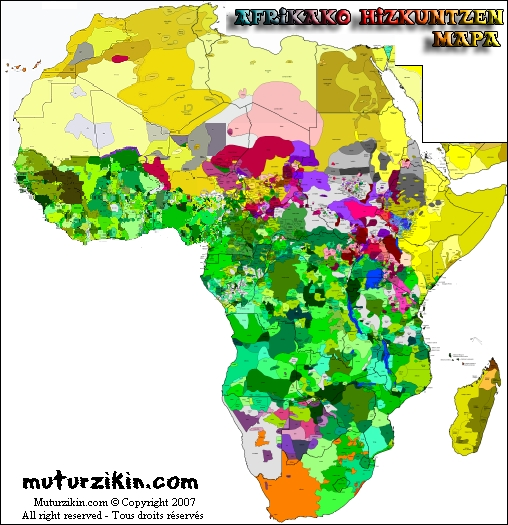
Courtesy of muturzikin.com
Because there are more resources in tropical areas, less area is needed to maintain a bribe. Hence, tribal/language density is greater in the tropics than in temperate zones. Obviously, knowing a second or third language has great survival benefits in the tropics as compared to other areas. Europe also has a fairly dense language map, and it would be interesting to compare the two.
These are only preliminary thoughts. I’m not making any conclusions, just suggesting that those smarter than me, or with more resources, might consider looking into these topics.

