Abuna Yemata Guh

“Abuna Yemata Guh.” The name probably doesn’t ring a bell for most of y’all. Your city probably has no streets with this name, or schools… or churches.
I had just spent 3 days in the second lowest place on Earth: Danakil. My body had acclimated to this low elevation, so in hindsight, it’s no wonder that when I found myself at higher elevations, the very next day, I woke up extremely tired, unsteady, lethargic, lacking an appetite and suffering from general malaise. My legs still ached from the 9 KM hike up to the volcano, and the description of my next activity (based on my tour company’s schedule) led me to believe this would be a leisurely day of sightseeing. The description read: “Tigray churches.”
We entered the town of Hausen, and set about finding my local guide. I was relieved when I found out it wasn’t going to be this guy:
tig22
I was given a choice: Visit two so-so churches or visit one spectacular church. Naturally, I chose the latter. My “leisurely day” turned out to involve a steep hike up this mountain:
tig18
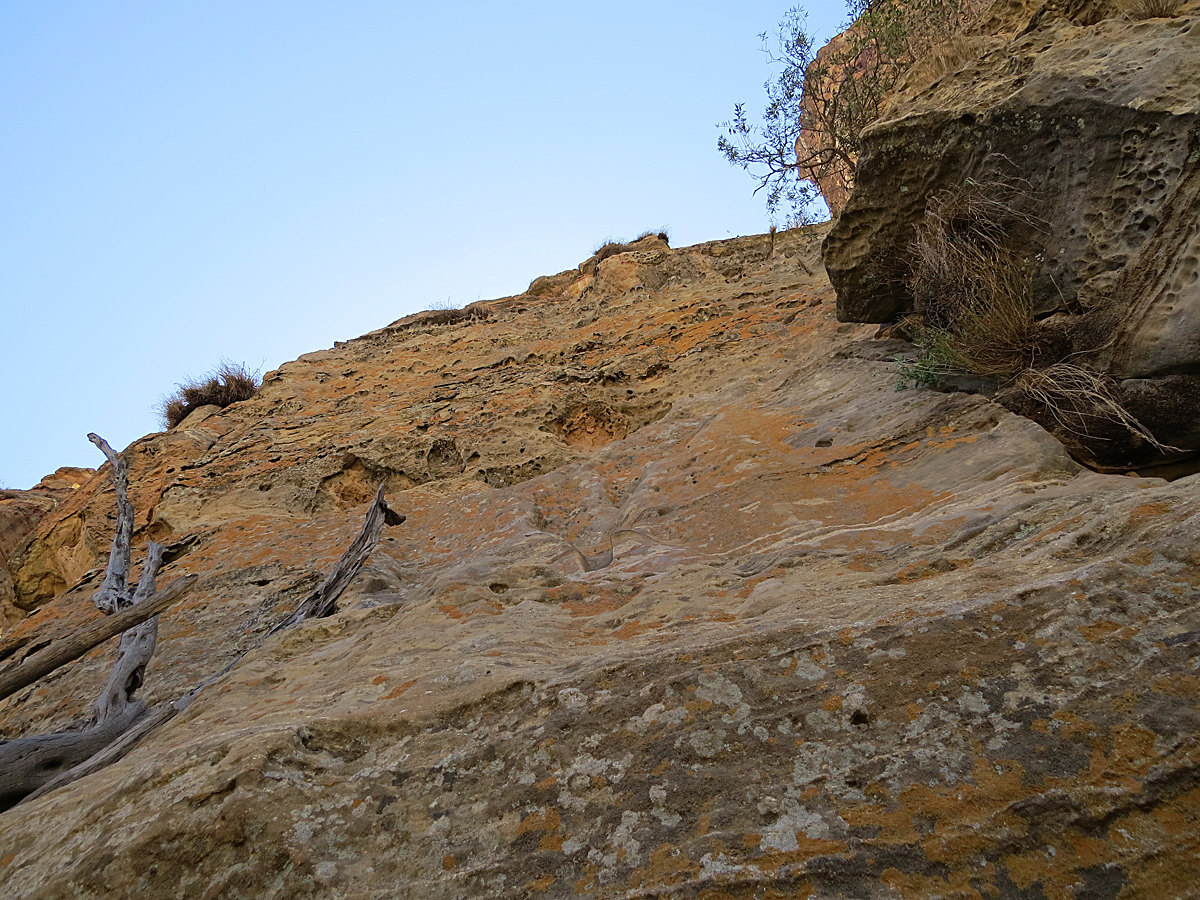
It was hot and I was thirsty, and I’d only brought a small amount of water. In my condition, the hike was a real challenge. I had to stop every 5 minutes or so to catch my breath. But there was shade, and there were cool rocks to rest my body against, so I soldiered on. On the way up, a descending Scottish tourist gave me what he had left in his water bottle. I was grateful for that, and it did rejuvenate me. After an hour or so of this, we got to the “hard part.” It was about then that I recognized this place from a Youtube video. I had seen an elderly monk do this climb with ease. If he could do it, so could I. What presented itself before me was a sheer vertical edifice, described pretty well in this article. Perhaps my altitude sickness had clouded my judgment, but at this point I was feeling well physically, so, with several helpful hands guiding me (after removing my shoes, as required), I started up:
tig17
It was the scariest thing I did in Ethiopia. A fall from there meant certain death, and at one point, my only support was a dead tree branch lodged in the rock. After the initial steep ascent, there’s another, less frightening stretch. After that, I reached a plateau, which consisted of a boulder perched between the rock spire that contained the church and the mountain below. This is where people were brought for burial in ages past:
tig15
After crossing over the boulder, there’s a narrow path around the rock spire:
tig3
It’s about a thousand foot drop off the ledge, but a few feet away was the entrance to the church. Accounts vary as to when it was built, but there is no dispute that it’s a very special place:
tig28
tig42
tig44
tig36
Here’s the view out from the entrance:
tig8
Lonely Planet sent a photographer to Abuna Yemata Guh, and he put together a nice Youtube video about it.

Posted in travel | Tagged | 7 Comments

My encounter with a Rastafarian

On my second day in Ethiopia, we stopped in the city of Shashamane. In 1948, emperor Haile Selassie allowed a number of Jamaican Rastafarians to settle in Shashamane, and since then it has had a small community of these people.
hawa103Our main point of interest was the Banana Museum/art gallery. It was founded, and features the art, of one individual: Ras Hailu Tafari, formerly known as Bany Payne.
hawa104The museum features works of art, mainly portraits of the late Emperor Haile Selassie, made out of banana leaves. It also contains a wide variety of medals given by the late emperor, and various books.
hawa112There were some questions I’ve always wanted to ask Rastafarians. The owner wasn’t particularly busy when we found him, so I posed a couple of questions to him.
hawa122I asked him how people who claim to follow the Bible, can also worship a human being: Haile Selassie. His answer was that the emperor was more perfect than you or I. I wanted to ask him if he believed Haile Selassie was more perfect than Moses, whose burial place was kept secret lest people worship him. But he continued to the related topic of how black people are God’s chosen people. At this point, I pointed out that Haile Selassie wasn’t really black. One glance at him will tell you that he was primarily of Caucasian stock. Tafari dismissed this by claiming, in so many words, that dark skin was all that really mattered.
I asked him for biblical sources to back up his claim that Ethiopia was of special significance. He brought out a book of Psalms and showed me a verse or two that listed, among other places, Ethiopia.
He wears a marijuana emblem on his shirt. So I asked him what religious significance marijuana has for Rastafarians. His answer was that it holds no religious significance. Rather, they are herbalists, and they respect the medicinal properties of marijuana. I was told, by an Ethiopian I’d met at the airport, that it was the Rastafarians who introduced “ganja” to the local Ethiopians.
This man was very agreeable, and pleasant, to be with. His artwork is impressive; it’s amazing what one can do with banana leaves. But from a theological point of view, I’d say that his ideas are crazy.

Posted in travel | Tagged | 3 Comments

My favorite Erta Ale video and some thoughts

I took many videos of Erta Ale, and I would have spent all day watching it if I could have; it’s that mesmerizing for me. Here’s my favorite video, which I just uploaded today:
[youtube https://www.youtube.com/watch?v=wQ6FKBa5fmc&w=560&h=315]
 
I’m back in Addis Ababa, and have regular electricity and internet access. It’ll be nice to get back to the U.S., where I can speak English and people understand me… well, at least most of the time. Today, I wanted to get to a specific place, and the taxi driver had no clue where he was going. He might have tried to clarify the destination before heading out. But no. Instead, he took me to one incorrect destination after another, each time asking directions.
It’s just one example of the inefficencies I’ve seen in Ethiopia. While in Harar, I noticed the cleaning lady sweeping the floor, and then mopping it, by stooping down and scrubbing it by hand. I asked why she doesn’t just attach a stick to the rag and use it as a mop; it would be much easier on her back and it would be more efficient. I was told: “That’s just the way it’s done here.”
While in Lalibela, I noticed that the multitude of flies caused misery for everyone, including myself. The soldiers were constantly shooing them away, and pilgrims suffered as well. This was around the church complexes. There were several small pools of stagnant water near the churches, which were full of maggots. I asked why they don’t just spray the water, drain it or find some other way to prevent flies from using these pools as hatcheries. I got no good answer. Apparently, nobody made the connection between the maggots in the water and the swarms of flies that afflicted us all.
At a hotel somewhere in the south, I had requested a knife and spoon to eat the fresh papaya I’d purchased on the street. I understand that there is a language problem; few people, even at hotels, speak English well. But when the employee brought me two knives, I had to ask myself, “what in the world was he thinking? What was I going to do with two knives?”
I’ve met some very intelligent people here in Ethiopia. Some of them have great insights, and I’d like to keep in touch with them. For the most part, staff at the nicer hotels are comparable to what you’d find in the U.S. But now and then I’m reminded of the studies that show Ethiopia’s average I.Q. as 70 or so.

Posted in Africa and blacks, travel | 7 Comments

Back from Harar

The last leg of my journey was Harar, a medieval city whose old city features narrow winding streets. The old city is surrounded by a wall. My guide told me that in the old days, the surrounding Oromo tribe used to raid Harar in order to abduct women for forced marriages. The Oromo were apparently more negro than the people of Harar, so they therefore coveted Harari women, who were more beautiful than their own. Both groups were mainly Muslim.
Today, Harar is a cosmopolitan city, at the crossroads between the Middle East and Africa. Its culture and traditional dress show strong Yemenite and Somali influences. It’s famous for its “chat” (or “gat”/”qat” as it’s known in the Arab world), and exports it to Djibouti, Somalia and Yemen. As in other parts of Ethiopia, Christians and Muslims live in peace. There seems to be no friction between the two groups, and they even sometimes marry each other.
Harar is also famous for the hyena feeding. This tradition, in its present form, was started by a man named Yousef around 30-35 years ago. He was featured on National Geographic. Here’s my own modest little video of this event, showing Yousef at work. I enjoyed it a lot more than I thought I would. It’s quite an experience to be face to face with these beasts.

Posted in travel | Tagged , , | 10 Comments

Update from Ethiopia

I just returned to Addis Ababa from Omo Valley. Visiting the Omo Valley area is almost like visiting another planet. In many rural areas, people wander about in full native garb, which sometimes means wearing nothing at all. I visited the Hamar tribe (attending their famous/infamous bull-jumping ceremony), the Karo tribe, the Xonso (or Konso) tribe, and the Mursi tribe (famous for their lip plates). We had contact with the Ts’amai tribe too – but only by virtue of having run over one of their goats with our vehicle. Not a pleasant experience; I’ll tell y’all about it later.
Here’s a video clip from the drive from Arba Minch to the town of Konso, where we spent the night before heading out to the Hamar village:
[youtube https://www.youtube.com/watch?v=IiroSJreLkc&w=560&h=315]

Posted in travel | Tagged | 9 Comments

I'm finished with north Ethiopia, and…

I’m now visiting the tribal south of Ethiopia. I wanted to post more updates, but internet, and electricity, is rather sporadic in these parts.
Lalibela, with its rock-carved churches, was impressive. Some other tourists I’ve met have told me that Lalibela was the highlight of their Ethiopian trip. For me, it was Erta Ale. The Gelata baboons are also high on my list. Here’s a video I shot of them, during the one day I was in the Simien Mountains:
[youtube https://www.youtube.com/watch?v=bMJEGrPjZ4I&w=560&h=315]
I’ve got more, but uploading to Youtube is difficult. Yesterday, I visited the Dorze tribe in the mountains near Arba Minch. They’re famous for their unusual houses and weaving. In fact, their name means “weavers.” They also have a bread they make out of “fake banana plants.” I thought it was rather tasty. Their traditional schnapps was interesting too, and very potent.
Some friends, in Portland (and even some fellow tourists here), have asked me, “why did you decide to visit Ethiopia?” To me, this is a ridiculous question. I suppose, if one’s idea of a vacation is sipping bear on a beach, then Florida or Hawaii would be a better choice. But I like to see history, experience exotic cultures, view wild animals in their natural habitat, visit geographical oddities and have some adventure. In this respect, Ethiopia is the ultimate. It’s got ancient ruins, volcanoes (I’ve seen, technically, 3 while here if you count hot springs and such), sulfur fields, numerous unique tribes, a distinctive cuisine, hippos, crocodiles, zebra, monkeys, baboons, ibex, a unique species of wolf, interesting birds (later, I’ll upload some nice photos of these) and even elephants and lions in some remote parts. Traditional garb is still worn in some places, and that’s a big plus for me. The music and dance varies from place to place, and some of it is pretty good.
But near the top of my list of reasons for visiting Ethiopia is the languages. Most Ethiopians speak Amharic, which is a Semitic tongue. I’ve always wanted to familiarize myself with it, and now I’ve been doing so. I’ve gotten to the point where I can just about read it. My initial impression is that it’s a hybrid tongue, with a Nilotic/Omotic substrate and a strong Semitic influence, I’m certainly no expert, but that’s just my initial impression. The Semitic part of Amharic definitely has some archaic features. It has some Arabic loan words, but these are easily recognizable.
Amharic isn’t the only Semitic language spoken in Ethiopia. Tigrinya is also widely spoken in the north, and I’d love to learn some of that. It retains more of the features we normally associate with Semitic languages, sounding more like Arabic or Hebrew. It’s considered to be a more direct descendant of Ethiopia’s “ancestral” (liturgical) language: Ge’ez, which I’d also like to study.
Ethiopian culture/religion is extremely rich and unique. Never, in my travels, have I encountered such strong local traditions, and such a well-established national identity, as in Ethiopia. Ethiopians have their own calendar, their own way of keeping time, their own set of holidays, their own handshake, their own script/language, and their own art styles.
Watching Ethiopian Orthodox worshipers, I’m reminded of Orthodox Judaism in some ways. They’ve clearly borrowed much from the Jews. Israeli tourists (of which there are many; they have direct flights from Tel Aviv) notice this too. Ethiopia is full of livestock. Everywhere you go, even in Addis Ababa, there are cows, goats, mules, horses and camels (in the north). Ethiopia has more livestock than any other African country (so I’m told), but I have yet to see a single pig.
Well… I’d better post this now, before the electricity goes out again.

Posted in travel | 11 Comments

Something to whet your appetites: Erta Ale

Here are a couple of many videos I took at the famous lava lake in the Danakil, Erta Ale, the only permanent one of its kind in the world:

Posted in Uncategorized | 11 Comments

To the mountains, and now a castle

My journey to the mountains took me through some towns where poverty is the rule. To call their dwellings “hovels” would be too generous. I did see some nice wildlife in the mountains, but I got sick and had to cut the hiking trek short. Today I’ll be visiting a large castle. It’s supposed to be spectacular.

Posted in Uncategorized | 7 Comments

Ancient ruins and high country

Yesterday I visited some ancient ruins. They are shrouded in mystery, and subject to interpretation. But this morning, I embarked on a journey that takes me high into the mountains – mainly to see some unusual animals.

Posted in travel | 5 Comments

Having great adventures!

Dear readers,
I’m having great adventures in a faraway land. A couple of days ago I visited an awesome volcano. The day after that a remote place of worship. Sore legs, high spirits, happy to be alive and many stories to tell upon my return – oh, and many interesting photos!

Posted in travel | 8 Comments