Ethiopia and Jews

The relationship between Ethiopia and Jews is complex enough to fill entire books, so don’t consider this post as a comprehensive source on this matter.
Most of y’all have probably heard of the Falashas. The State of Israel airlifted most of them to Israel during the 1980s and early 1990s, and it’s questionable if any remain in Ethiopia today. While in Lalibela, one man identified himself, to me, as “Falasha,” but I was later told that such tall tales are commonly told to tourists. As to the question of whether the Falashas are true ethnic Jews, I remain agnostic.
There is an undercurrent of animosity toward Jews in Ethiopia. This is due to the commonly held belief that a Jewish queen destroyed most of the holy city of Aksum centuries ago. I’ll quote the Jewish Encyclopedia:

In the tenth century a Jewish queen named “Judith” (or “Esther” or “Terdaë-Gobaz”), at the head of the Falashas of the province of Semien, appears to have dethroned a king of Abyssinia at Axum, and to have established a dynasty which occupied the throne for about three centuries. Joseph Halévy has doubted this story, and not without cause, as further researches have shown. Under the rule of Amda-Seyon I. (1314-44) Jews dwelt in Semien, Wogara, Ṣalamt, and Ṣagade. One of this king’s generals suppressed a rebellion in Begameder, inhabited by Christians converted to Judaism. A Falasha revolt took place under Isḥaḳ (1412-29). The reign of Zara’ Ya’eḳob (1434-68) was also troubled by a rebellion of Amba-Nahad, the governor of Salamant; of Sagay, governor of Semien; and of Kantiba, all of whom had abjured Christianity and become Jews. The latter were then rigorously persecuted, as also under one Marḳos, general of Baeda-Maryam (1468-78), son of Zara’ Ya’eḳob.

The very name of Queen Judith (pronounced “Yodit” in Amharic) is held in disdain to this day. But this animosity does not appear to translate into resentment toward modern Jews. Ethiopia is a popular tourist destination for Israelis, and there are direct flights from Tel Aviv to Addis Ababa. Although one Israeli tourist told me they’re warned that it’s best to keep their Jewish ethnicity discreet, I’m not aware of any attacks specifically against Jews in Ethiopia. I never kept my Jewishness a secret, and if ever it came up, I got a smile and a handshake.
Israel helps Ethiopia in the agricultural sector, and has provided emergency food aid in the past. When I encountered a native (in the south) wearing a Hebrew t-shirt, his explanation was that he got it from Israelis who were there on an agricultural project:
tri28
In my view, Israel’s policy of helping Africans help themselves in their own lands, while preventing the mass migration of Africans into Israel, is the correct one.
If you’ve read my earlier post, about my encounter with a Rastafarian, you may recall that he cited biblical evidence for the significance of Ethiopia. Though a country by the name of “Kush” is mentioned in the Bible, and this is typically translated as “Ethiopia,” the matter is anything but clear.
For starters, the very term “Ethiopia” had different meanings in ages past. From Wikipedia:

The name Ethiopia also occurs in many translations of the Old Testament, but the Hebrew texts have Kush, which refers principally to Nubia.[37] In the New Testament, however, the Greek term Aithiops, ‘an Ethiopian’, does occur,[38] referring to a servant of Candace or Kentakes, possibly an inhabitant of Meroe which was later conquered and destroyed by the Kingdom of Axum. The earliest attested use of the name Ityopya in the region itself is as a name for the Kingdom of Aksum in the 4th century, in stone inscriptions of King Ezana, who first Christianized the entire apparatus of the kingdom.

In the book of Samuel2 18:21, it says:

Yoab said to the Kushite, “Go tell the king what you have seen.” So the Kushite bowed down to Yoab and ran…

The commentary of Rabenu Dawid ben Qimhi (a noteworthy Spanish rabbi 1160-1235) explains:

He was from the children of Kush, and he converted. Or it’s possible that he was Jewish, but black like a Kushite, and that’s why they would call him “Kushite.”

Among Mideastern Jews in Israel, a person can be referred to as “blackish” (sheharhor) even if he’s darker than average, or of brown complexion. Such a person can also be likened to a “Kushi.” I have no idea how far back this usage goes.
The Bible also mentions Tirhaka, king of Kush (Kings 2 19:9). King Tirhaka is described as leading an army to meet King Sennacherib of Assyria – but Assyria and modern-day Ethiopia were too far apart to have been any threat to each other, at least in my opinion. So this is more evidence that the Biblical “Kush” was not what we now call Abyssinia or Ethiopia.
It was a Christian Aksumite army that crushed the Jewish kingdom of Himyar in the 6th century. From Wikipedia:

The Jewish monarchy in Ḥimyar continued for several decades, with one interruption. It finally ended with the reign of Yṳsuf, known as Dhū Nuwās, who in 523 attacked the Christian population of Najrān. [12] (These events, long attested to by Syriac, Greek, and Arabic sources, had until recently been largely dismissed by Western scholars as implausible, but recent discoveries of period inscriptions seem to leave little doubt regarding the historicity of the sources).[citation needed] Word of the slaughter eventually reached the negus of Axum, who invaded Ḥimyar in 525, conquering it and deposing Yūsuf.[citation needed] Ethiopian Jewish tradition describes a second Jewish kingdom that arose soon after, the Kingdom of Semien.[citation needed]

According to Ethiopian folklore, which many of them truly believe, their nation was founded by the union of King Solomon and the Queen of Sheba. They had a son, whose name was Menalik. He founded a dynasty, which ruled, with few interruptions, until 1974. Here’s a more full account of the Ethiopian tradition:

Whilst it cannot be proved that the Queen of Sheba had a son with King Solomon, but there is evidence of the Queen of Sheba’s visit to King Solomon in Jerusalem, in the Old Testament of the Holy Bible, the First Book of Kings, chapter 10, verses 1 – 10 says:

The queen of Sheba heard of Solomon’s fame and came to test him with hard questions…

When Menelik grew up (about 22 years old), he asked his mother who his father was and told him that it was King Solomon of Israel. Menelik told his mother that he wanted to go to visit his father in Jerusalem. He went to Jerusalem to visit his father and Solomon received him with great honour. Menelik stayed with his father in Jerusalem and learnt the Law of Moses for 3 years. Menelik looked very like his father, which confused the Israelites as they had difficulty in telling the difference between Solomon and Menelik. Because of this confusion they complained to King Solomon and asked him to send Menelik home. King Solomon said if they wanted him to send his son back home the high priests would have to send their oldest son and 1000 people from each tribe of Israel with Menelik. The high priests agreed to send their oldest son and 1000 people from each tribe with Menelik.
Menelik then returned to Aksum, amongst those accompanying him was Azariah the son of the high priest (Zadok) of the temple of Jerusalem. Before the journey Azariah had a dream that told him to take the Ark of the Covenant with him to Ethiopia. Azariah did what the dream told him to do and he stole the Ark from the Temple, putting in its place a copy. Azariah told Menelik what he had done and Menelik was angry with him but Azariah convinced Menelik to take the Ark with them. Zadok, the high priest of the Temple, discovered the Ark’s disappearance and informed King Solomon. King Solomon and his army followed Menelik but could not catch him. Whilst this was taking place Solomon dreamt that his son should have the Ark and he returned to Jerusalem and ordered his high Priests to keep its disappearance a secret.
On his return to Ethiopia, Menelik founded the “Solomonic Dynasty” and the Aksumite kingdom adopted Judaism and the Law of Moses. The visit of the Queen of Sheba to King Solomon as mentioned in the Holy Bible signifies to the Ethiopians their claim to be direct descendants of the “Solomonic Dynasty”. This shows that Judaic culture was established and followed in Ethiopia since the reign of King Menelik. When the Aksumite kingdom accepted the arrival of Christianity, during the reign of King Ezana in the fourth century, the Felashas (Beta Israel or Ethiopian Jews) refused to accept Christianity and continued to practise Judaism, which they still do today.

It’s always seemed to me that this legend is fanciful, and was perhaps an attempt to explain (among other things) the typical Ethiopian appearance, which differs from the appearance of most Africans around them. But they do have some pieces of evidence to back up their claim.
Evidence that “Sheba” (as in the Queen of Sheba) was in Ethiopia, can be had from the reputed remains of her palace near Aksum. This is one of the sites I visited while there:
ax92
ax101
Actually, they claim that her palace is located underneath the ruins we see above. Archeological evidence indicates that those ruins are from around 1000 BC – roughly the time of the Queen of Sheba. Here’s an article that sums up the evidence. My local guide also claimed that the fact that Falashas lived in this general vicinity also serves as evidence.
Ethiopians believe that the Ark of the Covenant is located in Aksum. They say it’s housed in a church there. Outsiders aren’t allowed to get very close to the church, but here are some shots I took from the outside:
ax122
ax109
I thought it was odd that they use street lamps to illuminate the exterior of such an important site:
ax121
Other Ethiopian churches have replicas of the Ark, which they remove for parades on special occasions. But nobody’s allowed to see the real thing, so we must take it on faith… or not.
Among the designs on the interior of one of the churches in Lalibela is a Star of David:
lal58
My local guide there told me that this is evidence of an ancient link between Ethiopians and Jews, but I pointed out that the Star of David only started being considered a symbol of Jewry during the Middle Ages. In ancient times, if there were such a symbol, it would have been the six-armed candelabra, the “menorah.” Of course, the churches were built during the Middle Ages, so the intention might, indeed, have been to show solidarity with Jews.
We can say, in summation, that Ethiopia’s relationship with Jews has been a love/hate relationship for a very long time.

Posted in Jewish stuff and Israel, travel | Tagged , | 11 Comments

Odds and ends from Ethiopia

Here are some odds and ends, mostly photos, from Ethiopia that I think are worth sharing, but got left out before.
Another crashed truck. Yes, I actually have a collection of crashed truck photos. Somebody could just drive around (as a passenger, of course) Ethiopia and photograph crashed trucks. A macabre project – but probably a unique one. I was told that the drivers don’t sleep enough:
ax3
The traditional bread is “injera.” This is fairly well-known, but less well known is the traditional table, upon which the injera is served. It’s carried around from function to function, like this:
ax14
Here are some children displaying (selling) their baskets in Aksum:
ax89
Speaking of Aksum, I was standing near one of the historical sites, speaking with my guide, when all of a sudden I heard a thump and saw something drop right next to my guide’s friend a few feet away. A bird had dropped a dead rat from the sky, and it almost hit the man. It would have been a better story had he been hit, but then again, it would have been an even better story had I been hit. Sometimes the best story is not the best story.
Did you know that Aksum is Denver’s sister city in Ethiopia? Well it’s true, and there’s even a “Denver Street” there:
ax105
How basic can a museum get? Pretty basic in the Bahir Dar area. One of the islands features this museum, whose walls are made of corrugated iron, and consists of but one room – with no lighting of any kind, so flash photography is recommended. But it does feature an armed guard!
bah69
Dung is used for fuel in much of Ethiopia. One can see heaps of it, neatly stacked:
hawa14
Here’s a little girl from one of the villages in Danakil. Sugarcane is the snack of choice for kids, and I was impressed at how efficient this girl was in eating it; she’s like a machine!
dan280
Here’s our local guide to Dallol, Ali:
dan211
Here’s the interior of one of the rooms in the guesthouse I stayed at in Harar:
har52
Here’s the customary Ethiopian handshake. My guess is that it’s used elsewhere as well:

[youtube https://www.youtube.com/watch?v=0TxCRbp3sF8&w=560&h=315]

Here’s a view of a Somali refugee camp, taken on my return trip from Harar. Incidentally, a large chunk of Eastern Ethiopia is ethnically Somali, and it’s known as “Ethiopian Somalia.”

har170

Here’s the priest at Abuna Yemata Guh. I probably should have included this photo in my original post; it’s practically a tradition for tourists to get just such a shot:

tig33

Practically every restaurant in Ethiopia has its coffee station, tended to by the coffee-girl. It’s her job to tend the coal fire for the incense, and to keep the coffee hot. Some people call this the “Ethiopian coffee ceremony,” but it’s not a ceremony; it’s simply the way Ethiopians drink coffee. Here’s one such station at the airport in Lalibela:

arb95

Speaking of airports, here’s an interesting scene I shot at the Addis Ababa airport. A little creepy, and a little artsy:

arb37

That’s it for now, but I’ve got a lot more, about Ethiopia, to write about.

Posted in Uncategorized | 6 Comments

Odds and ends from south Ethiopia

Here are some miscellaneous items, mostly photos, from south Ethiopia that I missed in my earlier posts.
Even with the crudest architecture, one can sometimes see creativity, as in this house/shop in the south:
arb53
This is the traditional type of dress found in the area of Konso, also in the south:
arb60
The area around Arba Minch (in the south) is famous for its bananas. They’re small, but very tasty, and they’re exported to many places.
arb86
Baboons also like the bananas, which is a problem for the locals. These girls are selling us bananas through the window of our car:
arb81
Moringa is a leaf that’s eaten in the south of Ethiopia. In fact, it’s a staple there, and it has medicinal properties. People can be seen carrying it, in large bundles, all over (the girl in front is carrying a bottle of local beer):
arb94
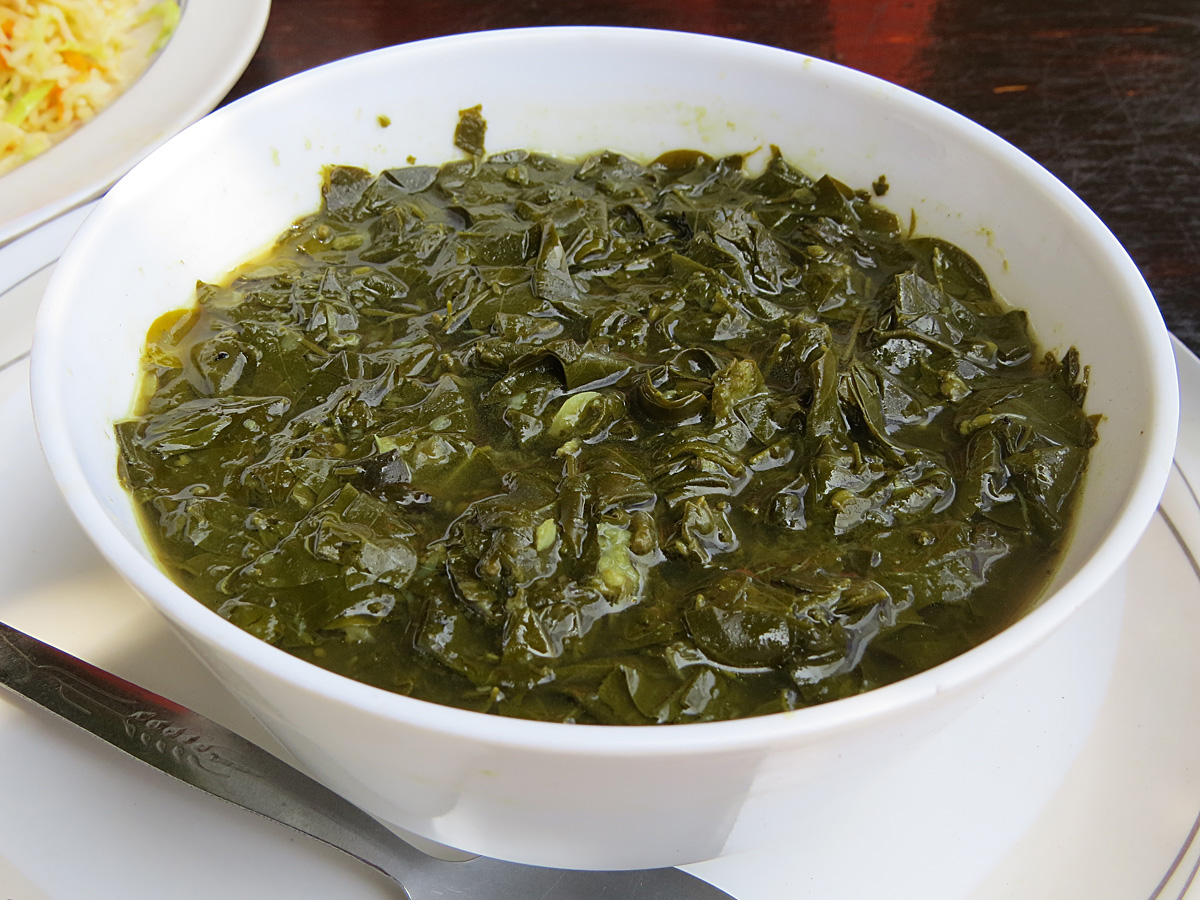
School kids carry small bundles of moringa over their shoulders, presumably for lunch. I’m sure that, prepared properly, it’s quite tasty. But Hiromi, Shun (my Japanese co-tourists in the south) and I tried some at a restaurant in Jinka, and it was so strong none of us could eat more than two or three spoonfulls. It almost tastes like spinach on steroids.
 
tri82
 
Honey is an important product all over Ethiopia. Here we see how it’s gathered in the trees:
 
arb77
Earlier, I mentioned the Dorze vendors selling their wares by the side of the road. Here’s a photo I neglected to include in that post:
 
arb31
 
According to my driver, it’s illegal to sell charcoal in the Rift Valley. The authorities don’t want people chopping down too many trees. Yet it’s sold openly all over, as we can see here:
 
arb42
 
Subsistence agriculture, using animal labor, is common all over Ethiopia. My guess is that the same is true over much of Africa.
 
arb55
 
Flooding must be a problem during the rainy season, so many roads have deep drains on either side of them, as we see here:
 
cha76
 
I couldn’t help but wonder how many people, and animals, have broken legs falling into those ditches, or how many vehicle tires have gotten stuck in them.
Common in the south are huge termite mounds. I’ve seen larger ones in Australia, but not as tall as these:
 
tri49
 
tri50
I wouldn’t be surprised if they’re the tallest termite mounds in the world.
 

Posted in travel | Tagged | 4 Comments

There are no homosexuals in Ethiopia

I count, among my many talents, the ability to make people feel uncomfortable by asking awkward questions, or by telling random stories at inappropriate times.
But in Ethiopia, anyone can do it! All you have to do is bring up the subject of homosexuals. On my last day in Ethiopia, I was hanging out with a young hotel worker. He wanted to make my last day in Ethiopia a pleasant one (because he thought I wasn’t treated right by another employee), so he showed me around Addis Ababa, and I had a beer with his friends.
In the spirit of small talk, I told him how, on one of my layovers flying to Ethiopia, I’d noticed a lot of homosexual males making out with each other. I said, “It’s not unusual to see this sort of thing, but at that particular airport, it was all over the place. I was confused – until I remembered that I was in San Fransisco.”
“Men hold each others’ hands all the time. It’s no big deal,” he replied. Indeed, in Ethiopia (and black Africa in general) it is common for same-sex friends to hold hands or put each others’ arms over each others’ shoulders. It signifies friendship, and no more.
“I’m not talking about just friendship…” I explained.
His eyes widened, and he became animated. “Oh no! We don’t have that sort of thing in Ethiopia. If it does occur, it’s only because that person was raped, or abused, as a child and his mind was messed up.”
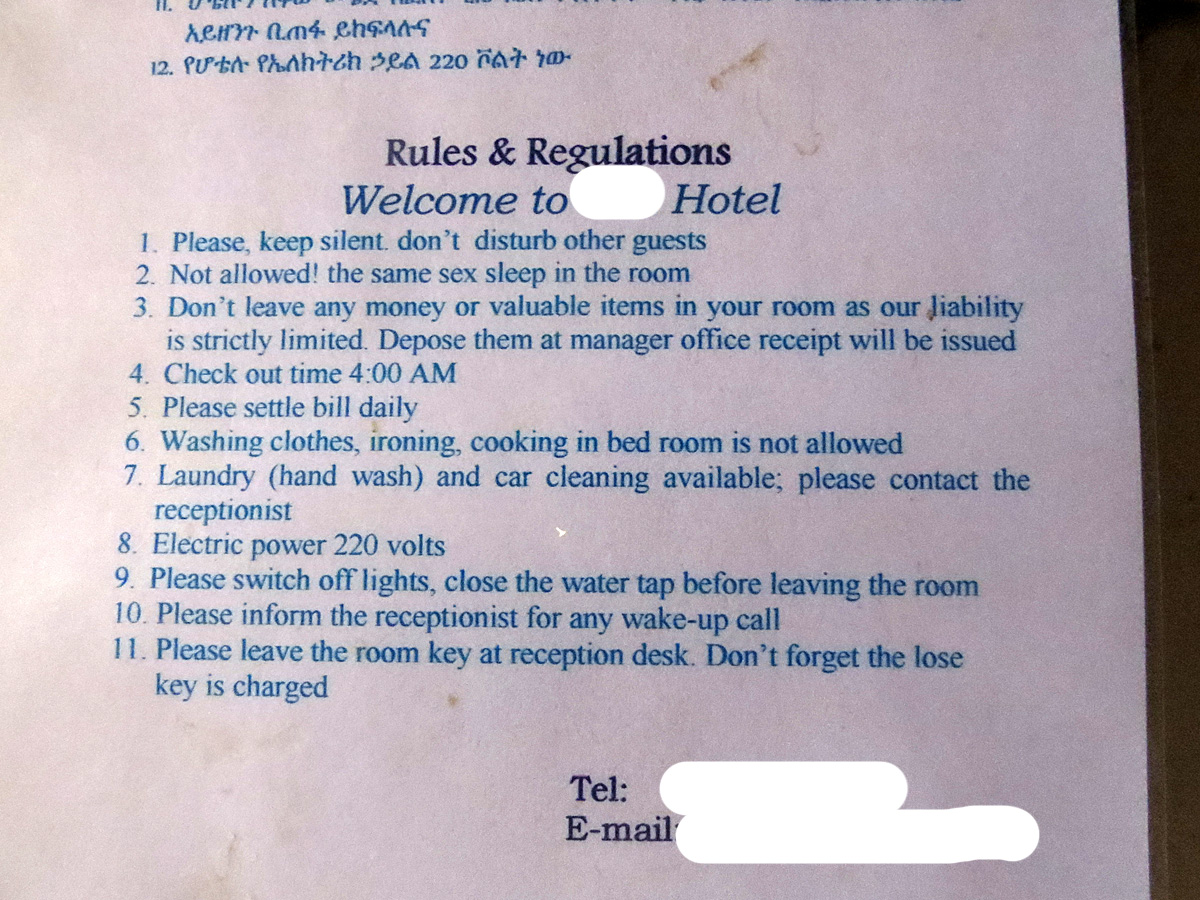
And that’s how I learned that there are no homosexuals in Ethiopia. Except that, while staying at a hotel in Jinka, in the south, I happened to notice a printout of the hotel rules in my room:
arb51a
I found rule #2 amusing but not surprising; Ethiopian law calls for the death penalty for homosexual activity – though I doubt it’s ever actually been carried out. I was told that this rule is common in Ethiopian hotels, though hotels that cater to Americans and Europeans might tone it down.
Even though I followed the rules at that hotel, I still got sick. My room had numerous insects, including mosquitoes, flying around, and this was a malaria zone. So I asked for some bug spray at the reception desk. They had some, and I sprayed it at the bugs as needed. I didn’t use much of it. Unfortunately, the window to my room had no screen, so I kept the window shut and, as I was tired, I laid down. After about half an hour, my throat was scratchy and I knew I was getting sick. The bug spray they use over there is much more powerful than what we have in the U.S. I’d poisoned myself, and I can still feel traces of the effect in my throat. Seasoned travelers to Africa know to bring their own window screens. Too bad I hadn’t thought of that.

Posted in human sexuality and morality, travel | Tagged , | 8 Comments

The Dorze tribe of Omo Valley

In all the excitement over the more famous tribes of Omo Valley (the Hamer and the Mursi), one tribe fell through the cracks and was left out: The Dorze. To all you Dorze reading this blog, I extend my sincere apologies, and I’ll make it up to you with this flattering post.
Unlike some other tribes, the Dorze don’t have extreme body modifications or bloody rituals, and they dress more or less like other Ethiopians. Nevertheless, they’re a cool tribe. Let’s start with their houses:
arb29
They’re built very tall. The reason for this is that termites eat the houses from the bottom up. By building them tall, they last longer. One can more or less tell how old a house is by its height. On the inside, they’re fairly cozy, featuring traditional homemade chairs:
arb22
They cultivate banana plants, but not the type of banana plants that bear fruit; they’re “false banana” plants, which bear no fruit. You may wonder why they would do such a thing, and the answer is that they use the pulp, from the stems, to make bread. It’s “false banana bread” and it’s quite good. First, they extract the pulp from the stems as shown here:

[youtube https://www.youtube.com/watch?v=-_wZYRbl2-M&w=560&h=315]

Then the pulp is sealed and left to ferment for several days:

arb18

arb21

Next, the pulp is diced until it has the right consistency:

arb17

Then it’s formed into patties and carefully cooked. Banana leaves are placed around it so that it doesn’t burn:

arb15

When it’s done, it can be served to hungry farenjis, along with hot sauce and honey:

arb12

It can be accompanied with traditional Dorze schnapps, which is also very good. You may be wondering how you say “le’hayim” in Dorze. They do it like this (the man on our left is my driver):

[youtube https://www.youtube.com/watch?v=HRsQoDPJSdo&w=560&h=315]

The Dorze are famous for their weaving and knitting. All along the road, leading to their villages, one can see them selling their wares. When they dance, they tend to use their buttocks. Coming down from the village, we were stopped by a “dancing roadblock.” The video gets interesting toward the end.

[youtube https://www.youtube.com/watch?v=vGWVj83oHg0&w=560&h=315]

Posted in Uncategorized | 2 Comments

Some lovely Ethiopian women

I’ve written about Ethiopia’s geology, it’s fauna, it’s cultures and its architecture – but no honest visitor to Ethiopia can deny that some of the most beautiful women in the world are found there. Indeed, this was the consensus of every single one of the other tourists I spoke to about this topic. It didn’t matter where they were from, which gender they were or how old they were. They all agreed that Ethiopia is home to many more than its share of stunning women. Some of them have already appeared on these pages. Most of the ones I saw just happened to be walking by, or were in other circumstances where it wasn’t possible to photograph them. Here are some photos I was able to take, but have neglected to post until now:
 
arb38
 
bah47
 
bah145
 
bah154
 
gon125
 
sim18
 
Female tourists told me that many of the men are handsome too. I did take some portraits of them as well. I’ll start with one of my local guide in Harar, Hailu (next to the window, shown with a friend):
 
har70
 
dan204
 
bah39
 
simi52
And I’ll finish with Dagi, my driver in much of the north. A fine fellow who had some hard times while I was there. I hope things are better for him now.
sim58


Posted in travel | 7 Comments

Melka Kunture, Lake Ziway, another rock-hewn church and a fish market

There are many important archeological digs in Ethiopia. One of these sites is Melka Kunture, which we (I was with a British tourist) visited. The site features a museum, which consists of several modest structures and some replica bones.
hawa18
hawa20
We took a boat trip on Lake Ziway, and saw many interesting birds.
hawa157
hawa84
hawa174
hawa182
hawa205
We stopped at an island, and hiked up to a popular church. On the ascent, we passed a hut, and the woman who lived there gave us some homemade injera.
hawa170
hawa171
The injera was on the gritty side, but the woman’s smile made it delicious. Here’s the church:
hawa169
I wish I could remember the name of the rock-hewn church we visited. It’s south of Addis Ababa. Perhaps somebody will recognize it and help me out:
hawa26
hawa40
hawa42
hawa30
We stopped at a fish market, whose location I also can’t remember:
hawa93
hawa99
hawa96
hawa107
At one point, we stopped at a restaurant by the side of the road. When they brought us the menu, it was covered with a multitude of small spiders! I guess you could say that spiders were on the menu. I tried to order several items, but each time they told me they don’t have that item. It appeared that all they actually had was spaghetti – so that’s what I had. I was hungry, so I tried not to think about the spiders.
As we were about to leave, I noticed that they did have one other item available: Raw meat.
[youtube https://www.youtube.com/watch?v=c9iZ6DgIedA&w=560&h=315]

Posted in travel | Tagged , | Leave a comment

The stelae of Tiya, Lake Shala and the Rift Valley

Almost as soon as I got off the plane, in Addis Ababa, ETT had me embark on a two-day trip to Awasa (also spelled Hawasa) by car. Due to the long flight, I was already very tired, but if I was to see all the things I wanted to see, there was no time to be wasted.
When we did, finally, arrive in Awasa, my room was on the fifth floor, and the elevator wasn’t working. On top of that, there was no water in my room. Not even cold water. A normal tourist would have been outraged, veins popping out of his forehead and waving his arms wildly. Instead, the following morning, I told the staff that if one of them sat down with me and tutored me on reading Amharic, all would be forgiven. I’d like to say that this lesson culminated in my being able to read Amharic well by the end of my trip. But I’m still working on it.
What of the two-day trip itself? I saw many things, so here are a few of them. I’ll follow up with one or two later posts.
Some 50 miles south of Addis Ababa lies the town of Tiya. On the outskirts of Tiya is a collection of monoliths, which is a world heritage site:
hawa62
hawa43
hawa54
According to my local guide, these are ancient tombstones, and the swords depict the number of enemies killed by the deceased. The guide also claimed that the people who erected these monuments were Semites. He said that this marked the border between the Semitic world and other language groups, such as Omotic and Cushitic.
We visited a large lake called Lake Shala. Near its shores are numerous hot springs, as you can see here:

[youtube https://www.youtube.com/watch?v=nsLi9Zr3AMM&w=560&h=315]

[youtube https://www.youtube.com/watch?v=rhGI1dKFsfI&w=560&h=315]

The lake water is high in sulfur, but nearby villagers have only this water to use. I was told that the discoloration in this boy’s teeth is a result of the sulfur. Feel free to correct me if you know otherwise:

hawa155

Here are some views of the Ethiopian Rift Valley:

hawa81

hawa71

hawa66

hawa68

Posted in Uncategorized | 6 Comments

The villages of Danakil

Our journey to the salt mines, and Erta Ale volcano, took us through a few villages. My understanding was that these were mixed Tigre/ Afar villages. They are very conservative, and the locals didn’t always appreciate our roaming around shooting photos. Sometimes there was tension in the air, but when one of the tourists, an Israeli, forgot his backpack at one village, it was still there for him days later when we returned. All the contents were intact.
I can’t remember the names of these villages, but here are some samples of the scenes, and people, of this leg of my journey:
It’s very common, in this part of the world, for men (but never for women) to carry a stick, if they’re tending livestock, over their shoulders. If they have a gun, it’s carried in the same fashion, as we see here:
dan268
In one area we stopped in, it’s customary to sharpen one’s teeth, as we see on this girl:
dan243
At one point, when we stopped to rest and take photos, we were accosted by a group of young men begging for bottled water. We were told that they’re road workers, and that their employer gives them water – but that they prefer bottled water. They all had crosses carved into their foreheads. They were more interested in water than in getting their photos taken, so this was the best I could do:
dan10
dan245
dan219
dan255
dan256
dan275
dan310
dan312
On the way to Erta Ale, we encountered a dust storm. This is where we stopped, for lunch, during that storm:
dan287
It was miserable, and here’s the “shelter” we used for lunch:
dan286
The village once had a medical clinic, but this is all that’s left of it:
dan289
Here’s a local guide/militiaman at the base of Erta Ale:
dan318
As we passed through vast volcanic areas, we could see isolated huts in the distance. We wondered how they survive in such a harsh environment, and how they get water:
dan295

Posted in travel | Tagged , | 4 Comments

Lalibela

As in other Ethiopian points of interest, the journey was almost as interesting as the destination itself. Here are some photos I shot on the way to Lalibela:
lal3
lal9
lal19
lal37
lal40
Lalibela is famous for its 11 stone-cut churches. I’ll quote Wikipedia:

Lalibela is a town in northern Ethiopia famous for monolithicrock-cut churches. Lalibela is one of Ethiopia’s holiest cities, second only to Aksum, and a center of pilgrimage. Unlike Aksum, the population of Lalibela is almost completely Ethiopian Orthodox Christian. Ethiopia is one of the earliest nations to adopt Christianity in the first half of the fourth century, and its historical roots date to the time of the Apostles.

I was able to visit all of the eleven stone churches in Lalibela; I didn’t have time to visit the ones outside of town. Here are some photos of the churches:
lal111
lal151
lal185
lal116
It’s impressive that these structures were carved out of solid rock without the use of modern machinery. I’m told it took 30 years to built each of these churches.
There are many catacombs among the churches of Lalibela. Most of them have been emptied, but not all of them. Here are some mummies that were left behind; I could have touched them if I’d wanted to:
lal104
It was crowded when I was there; there was some sort of festival going on. At one point, we had to traverse a narrow stone bridge that led into a narrow doorway into the church. This stone bridge had to accommodate two-way traffic – and there was about a 10-foot drop on either side. It was on this bridge, with people squeezed against us on all sides, that we had to somehow remove our shoes, and place them somewhere. Here’s a view of the bridge when it was a bit less crowded, before we used it:

lal44

Across from my hotel were a few gift shops. One of them is owned by a gentleman who claims to be Falasha. I had been wondering if there were any Falashas left in Ethiopia; most all of them had been airlifted to Israel decades ago, so I was overjoyed at having found one. When I told another local man about this, he laughed and said it was just a ploy to gain my friendship and trust – in the hope that I might sponsor him someday to settle in the US or Israel. He said such “tall tales” are commonly told to tourists, and that there are no Falashas in this area. Indeed, they were found mainly in the Aksum area, not Lalibela. But what do I know; I’m just a farenji (white person/tourist). I purchased a manuscript from Serash (the “Falasha”) and I think I got a good deal; it’s a beautiful manuscript, and I paid only $50 for it:
small ms1
I wandered about Lalibela with my local guide, and we visited some shops. There are interesting subjects to photograph in some of these shops. This one might have put the “bella” in “Lalibela:”
lal188
Posted in travel | Tagged , | 2 Comments