Is the U.K. Left turning a new leaf?

Thanks to Diversity Chronicle for sending me the following video:

[youtube https://www.youtube.com/watch?v=Tb2iFikOwYU&w=560&h=315]

At first blush, Mr. Phillips sounds like a breath of fresh air, when we compare it to the usual drivel we get from the British establishment regarding race. He acknowledges that there’s truth to the various stereotypes about different ethnic groups in Britain. He brings attention to the scandalous whitewashing of the underage grooming crimes in Rotherham, and he even acknowledges the fact that British whites feel marginalized – that it’s almost as if being white is now a crime in Britain.

But in reality, Mr. Phillips says nothing new in this video; most of his proclamations are now common knowledge. It’s upsetting that, while he does a good job illustrating the awful way the authorities reacted to the Rotherham scandal, he neglects to mention that it was the BNP that brought the matter to public attention in the first place. In fact, the BNP is not mentioned even once in the video.

This is probably because the BNP no longer presents a serious political challenge to the ruling parties – but UKIP does. Therefore, Mr. Phillips dedicates a substantial chunk of the last part of his video to making UKIP look bad. This, and the fact that the British media/government allowed this video to air in the first place, tells me that the video is naught but a political move. A pathetic attempt to fool voters into thinking that Labour has turned a new leaf, that they never meant to set up a Stalinist state of fear in the first place. That it was all just an oversight on their part, that they’re sorry and that things will be different in the future.

At the very end, Mr. Phillips even implies that white youth benefit from diversity, because they too might get their turn at having some attention lavished upon them – after the educational establishment is done lavishing attention on all the other groups! How absurd!

The video may be of some use in bringing the uninitiated to an awareness of the excesses of political correctness in Britain, but let us not be fooled by such ploys. Did Labour deliberately overreach, in their campaign of political correctness, just so that they could backtrack later and “reinvent” themselves politically? I wouldn’t put it past them.

Posted in examples of propaganda, freedom of speech issues, immigration/ Hispanics | Tagged , | 9 Comments

The road back to Addis and the "Merkato"

The drive back to Addis Ababa, from Harar, took a long time. It’s only one lane in each direction, and there are a lot of trucks in Ethiopia. One thing I noticed, almost from the beginning, is the shocking number of crashed, and overturned, trucks on Ethiopia’s roads. Scenes such as this are not uncommon:
har150
On a more positive note, camel caravans and traditional garb are very common in much of the area between Harar and Addis:
har157
har175
At one point, toward the end of our journey, we had to take a short detour due to roadwork.  The detour was a dirt road, and to our left (downwind) was a hut that was clearly inhabited by a family. The constant truck traffic sent relentless clouds of thick dust directly toward the hut. I couldn’t stand such dust for even a minute; breathing would be difficult, let alone eating, socializing, playing etc. I asked my driver how anybody could live like that. His answer was “you get used to it.” There were plenty of other places to move the hut to; I guess I’ll have to add this to the list of things I’ll never understand.
After a while, we reached the entrance to one of Ethiopia’s finest roads: The expressway to Addis Ababa. it’s a toll road, but well worth the price. Animals, and slow-moving vehicles, are not allowed on this highway. As for quality, signage and upkeep, it’s as good as anything we have in the United States, if not better. Of course, as soon as we got off, we had to contend with the notorious Addis traffic and construction.
Toward the end of my Ethiopian tour, I had the opportunity to visit the largest open-air market in Africa, the famous “Merkato” of Addis Ababa. It’s a rough and tumble place, where men and women sell their wares, and sweat for a living every day. In general, people there don’t like having their photos taken, but this doesn’t mean it can’t be done.
mer10
mer13
mer12
mer14
The pounding of metal, along with the smell of welding and smoke, really adds to the ambiance:

[youtube https://www.youtube.com/watch?v=why-KxSPOFI&w=560&h=315]

Speaking of metal, it’s interesting to see the uses for rebar in the third world. In Gondar, I saw it used on a tombstone:

gon116

The taxi driver who took me to the merkato used it to replace his window handle:

mer25

I concluded my visit to the Merkato by purchasing a fine leather belt for 60 Birr. The man initially wanted 200 Birr, but I didn’t need a belt that badly – so I offered 60 and started to walk away. That’s how great deals are struck in much of the world. 60 Birr is about $2.50. Not bad!

Posted in travel | Tagged , | 5 Comments

Harar: At the crossroads of civilizations

There was a communication lapse regarding my drive to Harar, from Addis Ababa, and I was stranded in a God-forsaken area near the coffin market for a couple of hours. It seemed I would not get to Harar in time for the famous hyena feeding. I made it back to my hotel, the fabulous, clean, friendly and reasonably priced Caravan Hotel, and resigned myself to remaining in Addis for the remainder of my trip.
But there are good, responsible, people everywhere on Earth, and Ethiopia is certainly no exception. The owner of ETT, Bisrat, took ownership of the problem – and sent a driver to my hotel to take me, immediately, to the airport; he had bought a business-class ticket, at his own expense, to get me to Harar as promised. To be honest, Harar wasn’t intended to be a highlight of my trip; it was more of an afterthought. But I was touched by this gesture of honesty and goodwill. Incidentally, “Bisrat” means “good news.” In Hebrew, it would be “besura,” and in Arabic “Bushra” (I’m warming up for my Ethiopian language posts).
Actually, Harar has no airport of its own. We landed in Dire Dawa, about 45 minutes away from Harar. The driver, Mohammad, was waiting for me at the airport, and the drive was a pleasant one. Though his English wasn’t the best, he managed to explain everything to me, stopped when requested and drove safely (unlike so many other drivers in Ethiopia). Here’s something I never thought I’d witness in real life:
har62
har61
I thought this sort of thing was only done in the movies! We passed through Harar’s markets, and saw much chat being sold. Harar is famous for its chat, and it exports the leaves to Djibouti, Sudan, Somalia and Yemen.
When we arrived at the guesthouse where I’d be staying, I met my local guide, Hailu. Every one of my local guides had been excellent, but Hailu was the only one to specifically state that he had no ambition to emigrate to the US or Europe; he feels it’s his duty to remain in Ethiopia and work to improve it. He certainly made my brief visit to Harar as special, and enjoyable, as it could possibly have been. He’s also a fellow cat-lover. Here’s his cat about to get fed:
har17
Speaking of getting fed, the time was approaching for the hyena-feeding, so off we went to the outskirts of town. Here’s one of the stars of this event:
har22
And here’s Yousef, one of the hyena men, at work:
har31
Some crazy guy allowed a hyena to perch atop his shoulders to be fed!
har33
Oh wait… that’s me. Never mind. Hey eldest daughter, do you recognized that shirt? It was a lot of fun, and I was the only tourist at the time.
Harar is the 4th holy city of Islam, and most of its inhabitants are Muslim. However, Christians live here as well – with no problems as far as I could tell. Traditional dress is not hard to find in Harar, and it reflects a strong Yemenite, and Somali, influence:
har5
har58
har98
har99
Men can be seen passing their days chewing chat:
har129
Here’s a banana vendor:
har118
Camel meat is eaten in Harar, and it can be seen sold at the market:
har65
har66
Here’s a view of the chat market:
har102
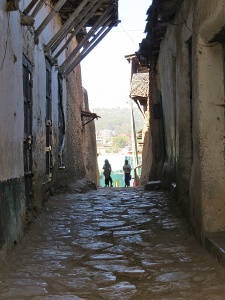
Harar was founded in medieval times, and the narrow, winding, streets of the old city reflect this:
har20
har87
They remind me somewhat of Cusco, Peru.
The last emperor of Ethiopia, Haile Selassie, was born near Harar. Here’s a view of the mountains where he was born:
har113
Notice the “W” shape? It has become symbolic of the emperor himself, and one can see houses with a “W” painted on them. This means the owners are loyalists, and supporters of the late emperor.
As mentioned, Harar is a holy city for Muslims, so it is home to many magnificent Islamic manuscripts, some of which I saw in museums:
har79
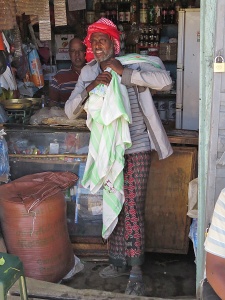
My guide, Hailu, showed me around the vast Harar marketplace, including the second-hand market, where just about anything can be found:
har139
The old city of Harar is a walled city, and like other walled cities, it has a number of gates. It also has gates specifically for the hyenas:
har105
har103
As we drove around the old city, I noticed people living in caves:
har112
I was going to write about the drive back to Addis, from Harar, in this post. But it can wait for tomorrow, or the next day.
Posted in travel | Tagged , | 4 Comments

The Simien highlands

Due to altitude sickness, my stay in the Simien highlands was brief. The drive to the base city of Debarq, up winding mountain roads, was both harrowing and beautiful. Here’s a view:
sim48
The road is almost exclusively dirt, but much of it is under construction, in the process of being paved, so we often had to drive around boulders and other debris. Sometimes, we had to wait for bulldozers to clear a path for us to pass. The workers are all Ethiopian, but their bosses, and the engineers, are Chinese. The Chinese are responsible for paving many, if not most, of the roads in Ethiopia – and they’re not doing so out of the goodness of their hearts. From what I could gather, Ethiopians have mixed feelings about the Chinese. On the one hand, they’re grateful for the paved roads, on the other hand, the Chinese are not known for their good manners and humility. Take smoking for example. While in Beijing, it seemed to me that almost everybody (at least the males) smoked, and they’d leave trails of butts and mucus everywhere. In contrast, very few Ethiopians smoke. While waiting for a flight in Addis Ababa, a couple of young Chinese men were sitting in front of me chatting. They weren’t bothering anybody, but the Ethiopians in front of them would periodically glance back at them with what seemed like a mixture of curiosity and wariness. Perhaps they didn’t find Mandarin pleasing to their ears. I think the Ethiopians are right to be wary of the Chinese; Ethiopia suffered immensely under communist rule, and the Chinese are (at least officially) communist. Ethiopia is a poor country, while China is (in comparison) an economic powerhouse.
Here’s the hotel I stayed at while in Debarq:
sim54
Just kidding! I stayed at a finer hotel than that one, and here are some of the employees there:
sim55
On the morning of my departure for the mountains, I took a short stroll through the town, and then hung out at the entrance to my hotel. Some kids came up to me and showed me a few bottle caps they’d collected from the ground. They were playing a game where they stack the bottle caps, and then stand back a few feet and try to hit them with rocks. I joined them in this game for a while, but I wasn’t able to hit the bottle caps even once. I blame the altitude sickness. Some official-looking adults were passing by. I think they were members of the city council, or something like that. When they saw a farenji playing with the kids, they reckoned at least one of them should participate as well. So they sent their most prominent member to play the game – and he hit the caps on his first try! Obviously, he is a great man. I duly congratulated him.
Here are some shots of Debarq and its inhabitants:
simi7
simi12
simi5
The drive up to the mountains took almost an hour. When we stopped, one or two other groups of tourists were also there. I recognized a British couple I’d shared a car with on my tour of Danakil. Martin and Rose, if you’re reading this, I hope everything’s going well with you in the UK, and that you enjoyed the rest of your trip.
One of our group was 70 years old, and he had no trouble with the hike. But I had to stop and rest every 5 minutes or so; my legs felt like lead and I would run out of breath very quickly. It was embarrassing, as I was holding up the group – and the initial impression was that I was simply in very bad physical shape. Still, I managed to get some decent photographs of the view:
simi18
and of some of the natives:
simi2
and the animals:
simi38
simi25

The highlight of this excursion was, of course, the Gelata baboons (more correctly spelled “Jelata”). Here they are carrying on:

[youtube https://www.youtube.com/watch?v=YYAWuu-4p9U&w=560&h=315]

American biologists would rather call them “monkeys.” Either way, they’re fun to watch, and they have very little fear of humans; I was able to get within 2 or 3 feet of the younger ones.
After that, it was another hour or so to the first camp, where we would spend the night – and clouds were starting to fill the sky. With great difficulty, I was able to make it to camp, though I lagged behind the others. Tents were already set up for us, and I collapsed on the ground inside one of them. Not five minutes later, the heavens opened up and rain poured down. Somebody brought me a mattress, and I was barely even able to find enough energy to maneuver myself on top of it.
A while later, they came to tell me dinner was ready, and I forced myself up to eat. I had no appetite, but the soup was delicious nevertheless. They practically forced me to eat solid food, and then I returned to my tent, where I tossed and turned all night. I ached all over and felt a bit nauseous.
The following morning, it was obvious I could go no further; I was convinced I’d contracted malaria. Ten days earlier, I’d been to Hawasa, which is a malaria region, and I had not taken my anti-malarial medication. Ten days is the incubation period for malaria and all the symptoms were there. I felt too cold in the shade and too hot in the sun, and I had to get off that mountain. The tour operators tried, for hours, to get somebody to stop and take me back to Debarq. I felt like I would die if I had to stay on the mountain one more night. Finally, a truck driver agreed to take me – for $50! I told him I’d pay him 500 Birr. Still way too much, but I was in no position to refuse the ride either. The truck was just like the large truck shown here:
simi17
It was not a comfortable ride. At least they put me in front. I was crunched up against other passengers and the ride was very bumpy. There were no seat belts for passengers, though the driver had one. The driver seemed to go out of his way to get as close to the ledge as possible, all the while chatting on his cell phone. We passed groups of Gelata baboons, but I was in no position to take photos. My plan was to stop at the Simien Mountain tourist office and call for help from there. But when we got there, after about an hour, the office was closed. I was forced to hire a tuktuk (a miniature 3-wheeled taxi) to the bus station. From there I took a minivan to Gondar. This wasn’t a pleasant journey either. It was crowded, nobody spoke any English, and the guy next to me kept shamelessly begging me for money.
When we arrived in Gondar, I had to hire yet another tuktuk to take me to my hotel. I felt better almost immediately, and an ETT driver came by to meet me soon thereafter. He told me that they’d been following me the whole way from Simien, trying to catch up with me in order to help. He took me to a nearby clinic, called “The Zebu Clinic.” They did a blood test and determined that I did not have malaria. Back at the hotel, the staff asked if I’d seen zebus in the Simien highlands. I answered, “No, but I did see the Zebu Clinic!”

Posted in travel | Tagged | Leave a comment

Bahir Dar and Lake Tana, source of the Blue Nile

Ethiopia is landlocked, but Lake Tana is large enough to be considered, by locals, a sea in its own right. Hence the name of the city that adjoins it: “Bahir Dar.” “Bahr” means “sea” in Arabic, and “dar” means “dwelling.” Some locals told me that “dar” means “next to” in Amharic, but I didn’t find it in my English-Amharic dictionary. Few Ethiopians, even Muslims, speak Arabic. Amharic speakers are, as a rule, unable to pronounce the gutturals so characteristic of other Semitic languages (such as the voiced “h” in “Bahr”) so it ends up sounding something like “Bar-dar”).
When we first arrived in Bahir Dar, we stopped to get something to eat and I noticed a “chat” (“khat” or “qat” in Arabic) shop across the street:
bah49
I’d been meaning to try some “chat” while in Ethiopia; it would be my second time, since I once tried some in Israel. I also wanted to get a better shot of the attractive, tattooed, lady, so I purchased some, and got a better shot of the shopkeeper as well:
bah46
Like many Ethiopian women, she sports traditional tattoos on her face, and I never tired of seeing them – or of photographing them. The chat had a somewhat sweet flavor, but I didn’t chew enough of it to experience any kind of psychological effect. My driver had been suffering from a stomach ailment, so we stopped at a local drug store. It was early afternoon, and the clock on the wall was correct:
bah43
Ethiopians count their hours from sunrise (what we would call 6:00) so 7:00 Ethiopian time would be 1:00 in the afternoon our time.
After checking into a hotel, my first order of business was a visit to the Blue Nile Falls, which is almost an hour outside of town. The drive was like many others in Ethiopia: Over dirt roads and through poverty-stricken villages. Upon reaching the end of the road, and the entrance to the park, I took a small boat to a footpath that led to the falls. On the way, locals sold their wares. Notice the larger coin the top woman is wearing around her neck. These “Maria Theresa Thalers” are used as jewelry all over Ethiopia. At one time, they were the common currency; I bought one of those later, on an island in Lake Tana for 350 Birr (about $18):
bah29

bah38

[youtube https://www.youtube.com/watch?v=NKv9J12fIhw&w=560&h=315]

I ended up buying that self same flute.  Here’s a view of the waterfall:
bah30
I was hoping to swim in Lake Tana, but other tourists warned me against swimming in African fresh water; I could end up with nasty parasites or worse. Instead, the next day, I joined a motorboat cruise on the lake. Almost immediately, we saw the reed fishing boats (called “tankwas”), whose design probably hasn’t changed for thousands of years, being used:
bah59
Then we spotted some monitor lizards on a nearby rock:
bah115
Hippos also occupy Lake Tana, and we got to see some of them too:
bah123
There are several islands, and peninsulas, in Lake Tana, and we stopped at three of them. Apparently, each island features its own church or monastery. Each one has an admission fee of 100 Birr.  Here is a photo inside one of the churches I actually entered. I think it was Ura Kidane Mihret on the Zege Peninsula:
bah104
Somebody else has written a much more comprehensive post about these churches. Check it out here. One monk caught my attention:
bah106
When I showed his photo to my local guide, Abebaw, he told me that the man was a soldier under the notorious Mengistu, the “Butcher of Addis.” I’m sure he had much on his conscience – or perhaps he has many enemies. Maybe both.
After Lake Tana, Abebaw took me on a very nice tour of the Bahir Dar marketplace and some highlights of the city. I think this is a good place to praise Abebaw, and the drivers/guides of ETT in general. Though I won’t discuss prices on this blog, after shopping around, it became clear that Ethiotraveltours (ETT) provided the best value, by far, for the money. The owner, Bisrat, is a very friendly guy. Both he, and his staff, take great pride in what they do.

Posted in Uncategorized | 4 Comments

The Karo and the Mursi (DANGER!!! Nudity!!!!!!!!!!)

Unlike the Hamer, or the Khonso or the Dorze, the Mursi tribe has no organized way of dealing with tourism. This is a shame, considering that they’re arguably the most interesting tribe in Ethiopia; they’re famous for their plate-lipped women, honey-hunting and blood-drinking.
According to some Ethiopians I spoke to, they’re also savages, lacking any religion (animism isn’t considered a “religion” in the eyes of some Christians and Muslims), prone to theft and lacking any respect for outsiders. The fact that clothing never really caught on with them also seems to demean them in the eyes of other, more progressive, tribes. One man, in the nearby town of Jinka, said “my people are civilized; we use clothes.” He told me of a hoary feud in which the Mursi killed a member of his tribe (I think he said he was Suri), and an elderly Mursi woman was killed in return.
Indeed, before visiting the Mursi village, we picked up an interpreter and an armed guard to accompany us.
But before all this, we had stopped at a Karo village. It was very picturesque, overlooking a magnificent river and ravine. These people had it good, but they were not opposed to collecting a few extra Birr from tourists looking for some nice photos:
tri34
tri32
The Karo, like the Hamer, practice bull-jumping – but they no longer whip their women. Other than than, I didn’t learn much about them; we spent very little time in their village.
The Mursi are mountain people, and the drive up to their area held some nice views. As we approached our target village, it started to rain. This made it extremely difficult for me to shoot photos from the car, something that I always endeavor to do, if not always very successfully. Shooting from the car means that I get candid images of local people, not posed, staged, shots. I’ll post a couple of these. It’s unfortunate that the quality isn’t good, but it does give them a certain spooky character. These were my first glances of the Mursi:
tri68
tri70
tri71
As soon as we arrived at the village, many women and girls gathered around us (I was with 2 Japanese tourists) and very aggressively prodded us to take their photos. Each photo would cost us 5 Birr (only a few cents). They grabbed our arms, pinched us, placed themselves directly in front of us, all the while announcing “discount! 5 Birr!” or other words to that effect. It was awkward to say the least, and somewhat dehumanizing as well. On top of that, in an effort to gain the attention of tourists, they’d wear their most outrageous costumes; obviously, they don’t go about this way normally. My understanding was that these costumes are intended for ceremonies. But we did get some interesting shots, and they did make some money, so I guess everybody won.
tri99
tri104
tri107
tri119
tri115
I had to venture to the outskirts of the village to find some Mursi men to photograph. These guys didn’t make themselves up for tourists; this is how they normally go about:
tri126
tri125
They spend their days exposed to the elements, their skin is rough and they are sturdy. The British man, who was living with the Hamer, told me the Mursi are “scary people.” I began to see what he meant. I approached one of their huts at random and took this photo:
tri111
I asked about the significance of the jaw bone near the entrance, and was told that it’s simply leftover food. I imagined Mursi women, lacking lower incisors (they’re taken out, at an early age, for the plates), gnawing on the jaw and then casually discarding it on the floor.
Here are a couple of shots my Japanese friends took. They just emailed them to me:
jap2
jap5
While wandering about (actually, trying to get away from the ladies), I saw a heavyset man sitting by a hut. He appeared, at the time, to be the only sane person in the village. It turned out he was the village chief, his name is Oli and he’s well-traveled. He spoke English, so we chatted a bit:
tri98
Oli has two wives. They would have cost him a total of 120 cows or so – unless there’s a bulk discount.

Posted in Uncategorized | Tagged , , | 18 Comments

A visit to the Hamer tribe (video at the end contains nudity)

In the far south of Ethiopia is a region called the Omo Valley. It’s home to several tribes, which have remained isolated until recently. To get to Omo Valley, I flew from Addis Ababa to the main city of the south, Arba Minch. Unfortunately, Arba Minch had only one functioning gas station, and we had to wait several hours for the tanker to deliver the diesel. A handful of trucks were in line ahead of us. From Arba Minch it’s several hours to the town of Konso, where we spent the night. From there, it’s another couple of hours to the Hamer town of Turmi, where they were due to hold the famous bull-jumping ceremony. On the way there, our vehicle had broken the leg of a goat belonging to a member of the Ts’amai tribe (who inhabit much of the area between Konso and Hamer territory. The driver got out to negotiate compensation and, after a while, I realized things weren’t going very well. So I got out too, and offered 500 Birr to smooth things over. For a while, it appeared as if we may have to load the goat on the vehicle and proceed to the police station – which would have taken all day, and cost us additional bribe money as well. In the end, the herdsman (who claimed the goat was pregnant – they always say that, I was told) settled for 1,500 Birr (about $75). He made off like a bandit, and I wouldn’t be surprised if he had intentionally pushed his goat in front of the wheel. My driver said we were lucky; further down, such matters are often settled with guns.
cha91
As we continued on our trek, we encountered various other tribesmen tending their herds:
cha95
Eventually, we reached the village of Turmi, and I got to wander about the marketplace. It was a somewhat festive atmosphere, and I was able to photograph freely, though if I wanted to photograph individuals, they’d ask for a small fee.
cha96
cha148
cha106
cha139
Many of the men mat their hair with mud, leaving a hole (or several) for feathers and who knows what else:
cha271
I visited a covered courtyard where a group of villagers were imbibing a local beer. Among them was a British man who had lived with the Hamer for several months. Apparently, he was trying to become an honorary member. He handed me the gourd/bowl they were drinking from, and I tried a little beer. It was warm and lumpy; I didn’t understand the appeal. Of course, without electricity, it would be difficult to have cold beer…
After a while, we were told that the ceremony was to begin. I paid 500 Birr (about $25) for the privilege of taking as many photos and videos as I wanted, and we headed off to another location outside the village. For the next hour or so, we watched the whipping ceremony, where women and girls taunt the men, and demand to be whipped.
cha207
Some of them dance, holler and blow horns – then hand the man a stick, with which he whips her back. She doesn’t flinch, but carries on as before. Meanwhile, other women sit by the side:
cha203
The whippings leave bloody welts, and these are treated with oil by other women.
cha210
One woman was taunting one of the men so severely that he was on the verge of tears. I gathered that he wasn’t whipping the women with enough vigor. My impression was that the Hamer don’t change their customs, or their rituals, on account of tourists; they don’t have these activities so that they can make extra money from us. As far as I could tell, the only concession they make, to the outside world, is that now most of the women cover their breasts during the ceremonies. In the village, many of them go about bare-breasted. Those men who were not actively whipping sat under a tree, preparing themselves mentally for what was to come next.
cha220
Next was the face-painting ceremony. Using pigment gathered by grinding two rocks together with water, a couple of young men had their faces painted. I suppose there’s a significance to the designs.
cha235
cha245
The culmination is, of course, the famous bull-jumping ceremony, which you can see here:
[youtube https://www.youtube.com/watch?v=TrI7iUV0pmg&w=560&h=315]
The whipping ceremony is brutal, and one tourist was in tears. It’s not something outsiders can understand, and I won’t even try. Oddly enough, other than that one odd custom, I found the Hamer to be well-mannered and hospitable. They handle tourism in a very responsible way, not letting it distort their way of life too much. The same cannot be said of the Mursi, at least the ones I encountered the very next day. Stay tuned for that.

Posted in travel | 3 Comments

Back from the wedding

Good new: The wedding was a success; my daughter is now married! A great time was had by all and I got to spend time with some wonderful people (including my other kids).
I hope you’ll forgive me for not sharing wedding photos with y’all. Instead, I’ll tell you about another place I visited in Ethiopia: Gondar, sometimes called the “Camelot of Africa,” and I’m dedicating this post to one of my regular readers: Milana.
Gondar is famous for its castles, of which here are some views:
gon16
gon26
gon12
These castles, of which there are several, were damaged during wars with Sudanese Darwishes and when the British bombed them, during WWII, in order to dislodge the Italians, who were using them as their military base.
The evening of my arrival, a couple of NGO workers and my guide visited some local nightclubs so that we could see traditional song and dance. Each part of Ethiopia has its own dancing styles, and here they tend to dance with their shoulders. Here’s a video clip from one of the clubs we visited. Sorry about the quality; the lighting was challenging:
[youtube https://www.youtube.com/watch?v=NyL7ORvDIbU&w=560&h=315]
The two NGO workers mentioned that they’d never seen anything like this Rwanda, where they work. In most of black Africa, local traditions are typically lost as soon as people move to cities – though I’m sure they’re dusted off and practiced for special occasions such as weddings or funerals.
Gondar is also home to the famous Debre Birhan Salasie church. Though badly in need of restoration in many places, the artwork is still impressive. Here are some views of the interior:
gon60
gon55
gon45
gon124
In Ethiopian art, holy people are always depicted full face or three-quarter view, while evil people are shown in profile. I noticed that evil people are also always depicted with pug noses, while the righteous are shown with straight noses.
Here are two employees from the hotel I stayed at in Gondar. I could tell they were nice people, because they posed in full face and three-quarter face:
gon24
This concludes my very brief account of Gondar, the Camelot of Africa.
gon103

Posted in travel | Tagged , | 4 Comments

Some cool animals from Ethiopia

Here are some animals, all in the wild, I photographed in Ethiopia. How many of them can you identify?
simi21
simi24
simi46
hawa88
hawa127
hawa130
hawa184
hawa210
cha10
cha27
cha39
cha14
My daughter’s getting married tomorrow. Feel free to wish me Mazal tov!

Posted in travel | Tagged | 11 Comments

The mystique of Aksum

My local guide in Aksum (also spelled “Axum”) told me there are no mosques in the city. When Muslims ask why this is so, the local Christians reply, “When  Muslims allow churches in Mecca, we’ll allow mosques in Aksum.”
Aksum is the holiest of cities for Ethiopian Orthodox Christians. It was the seat of the earliest Ethiopian monarchies – as long as we don’t count the ancient kingdom of Cush as “Ethiopia,” but that’s another story. According to Wikipedia:

The original capital of the Kingdom of Aksum, it is one of the oldest continuously inhabited places in Africa. Axum was a naval and trading power that ruled the region from about 400 BC into the 10th century. In 1980 UNESCO added Aksum’s archaeological sites to its list of World Heritage Sites due to their historic value…
The Kingdom of Axum had its own written language, Ge’ez, and developed a distinctive architecture exemplified by giant obelisks, the oldest of which (though much smaller) date from 5000–2000 BC. The kingdom was at its height under King Ezana, baptized as Abreha, in the 4th century (which was also when it officially embraced Christianity).

Today’s Ethiopians consider themselves the descendants of the Aksumites, even those who belong to the more southern tribes. I think this is akin to Americans referring to our “founding fathers” even if their actual ancestors only arrived in America a hundred years ago. Or modern Jews referring to the biblical patriarchs as “our patriarchs,” even when it’s obvious that many of today’s Jews are descended from converts. They’re our cultural/spiritual forefathers.
The language of the ancient Aksumites was Ge’ez, and modern Amharic Ethiopians consider Ge’ez to be the ancestral language of Amharic, even though the truth is much more complicated. Tigrinya is widely spoken in some parts of the north, and it is more clearly derived from Ge’ez. But there will be other posts on the languages of Ethiopia, so I won’t delve into this subject much here.
Of course, when I visited Aksum, I saw its famous obelisks:
ax30
ax25
Right next to this archeological site is a museum. The old man in charge of the museum gave me a tour, and I found some of the exhibits very interesting. Some of the Aksumite coins were so small they were hardly the size of grains of rice, and yet they were engraved; one needs a magnifying glass to make out the design. Unfortunately, photography is not allowed in the museum.
The museum’s walls are decorated with large murals depicting Aksumite kings and their soldiers and subjects. I couldn’t help but notice that these ancient Aksumites are shown as having olive complexions and Middle Eastern features, so I asked the guide about this. He took my arm, pointed to it and proclaimed, “The ancient Aksumites were your color. This is in our history and our tradition.” As for modern Aksumites, and Ethiopians in general, he echoed what I’d heard previously: “We are a mixed people.” I didn’t notice any difference, in appearance, between today’s Aksumites and other Ethiopians.
Also near the ruins is a gift shop. Among the various souvenirs being sold was an old Bible manuscript on parchment. Having a weak spot for old books, I haggled the vendor down to about half of what he was asking, and bought the manuscript. Soon enough, it became clear that such manuscripts are sold everywhere there are tourists, on the streets, in shops and in hotels. People continued to use manuscript books, in this part of the world, until fairly recently. So they are definitely not rare. I’d say this one is about 200 years old. Here’s a page from it:
ms1
Later, I saw a sign (inside the tourist office of the Simien Mountain park) warning tourists not to buy such manuscripts. It stated that they are sometimes stolen, and that they’re illegal to take out of the country. I was told that if I got it from a reputable dealer, and got a receipt for it, that it probably wasn’t stolen – but I couldn’t get a straight answer about removing it from the country. Apparently, it’s up to the whim of whatever customs officer is in charge at the airport at the time.
All shops in Ethiopia are required to provide receipts to their customers, and they certainly do; the government sends secret shoppers to make sure that such receipts are issued, so that taxes can be withheld. If the Ethiopian government really cared about manuscript bibles being sold to tourists, they wouldn’t allow them to be openly sold the way they are; they’d enforce the law the same way they do when it comes to sales tax. Instead, they allow them to be sold to tourists – and then, after the fact, warn us we may not be allowed to take them home.
As it turned out, there was no problem taking my manuscripts (I later bought another, smaller, one) out of the country. Nobody even asked. What I bought was old books, not national treasures – and they are certainly not rare.
Near the obelisks are also some underground chambers and temples, some Christian and some pre-Christian. Some of the stonework reminded me of the better Inca stonework one sees in Machu Picchu or Cusco, though this is much older:
ax68
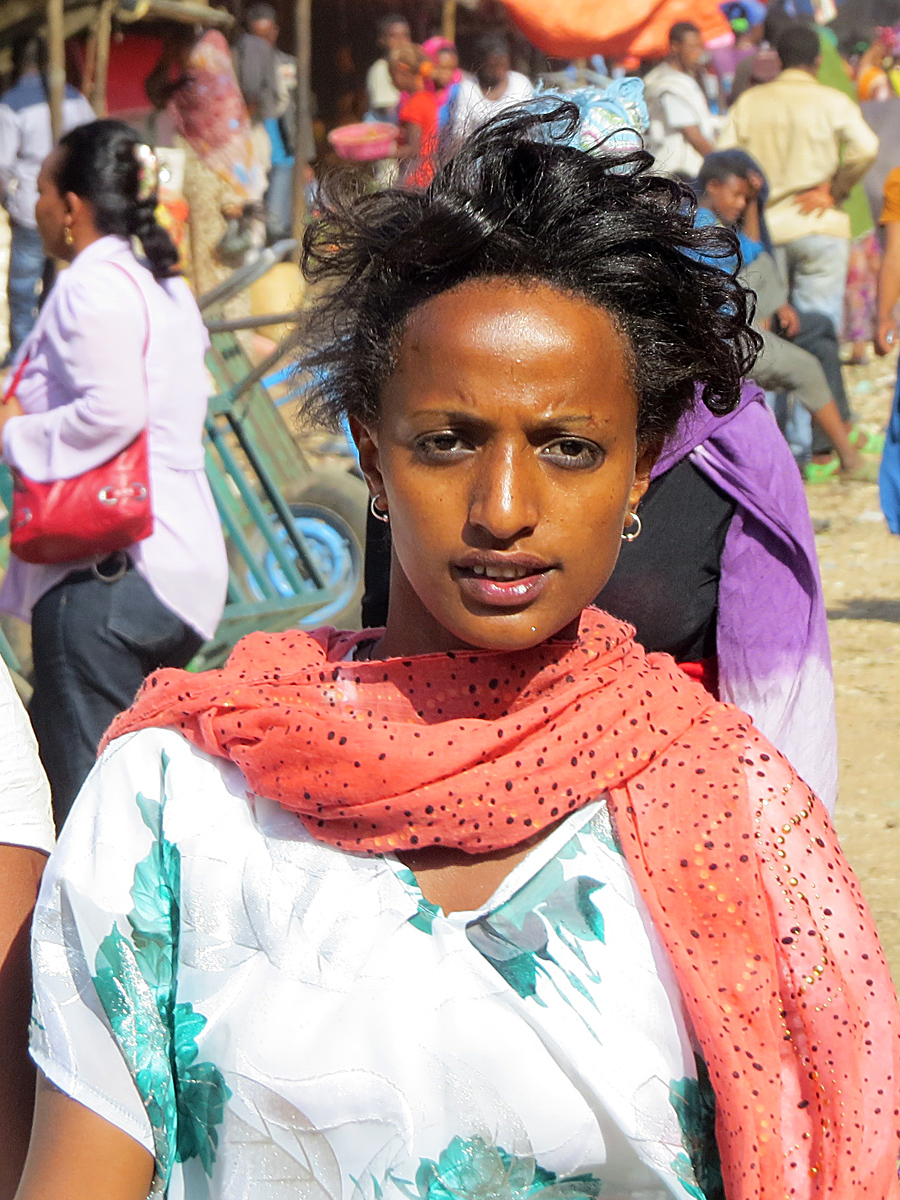
I’ll conclude with a modern Aksumite girl selling guavas, which were very tasty:
ax20

Posted in travel | Tagged , | 8 Comments